With lower snowpack across much of Oregon and early signs of dry summer conditions, wildfire preparedness is already part of the conversation in many rural communities. On the west side of the Cascades, spring rain can still influence how fire season unfolds. But when snowpack is lower, preparation becomes even more important.
In Sandy and surrounding areas, AntFarm’s Community Wildfire Defense Program is not waiting to see what summer brings. Backed primarily by funding through Oregon Conservation Corps via the Higher Education Coordinating Commission, along with workforce development support routed through regional partners, the program is training crews, expanding service areas, and reducing wildfire risk across rural Clackamas County.
“The goal is twofold,” said Logan Hancock, AntFarm’s Community Wildfire Defense Program Manager. “We’re building fire-adapted communities, and we’re developing skilled workers ready to enter forestry, wildfire mitigation, and related fields.”
Last year alone, the Community Wildfire Defense Program completed 352 Home Ignition Zone assessments and performed defensible space work on 193 properties in our area. Each assessment helps homeowners identify vulnerabilities. Each treated property represents reduced ladder fuels and improved structure survivability.
For Hancock, success goes beyond acreage. “The more skilled tree workers we develop, the better the service we provide,” he said. “We invest heavily in training. It builds long-term capacity and professionalism.”
Crew members begin with tree identification, introductory saw skills, physical conditioning, and fire behavior fundamentals. Those interested in climbing receive rigging and aerial rescue training. Winter windstorms recently shifted crews into storm damage cleanup and hazard tree removal, providing higher-complexity experience while meeting immediate community needs.
Recent funding has also allowed the program to expand to two operational crews, increasing capacity across North and South County. At the center of that expansion are young adults gaining hands-on experience.
Kaylee, who recently moved from Salem to be closer to family in the area, said she was drawn to the program for a simple reason. “I really like being outside, and I get to get paid to do that for work.”
What began as an opportunity to work outdoors quickly became technical training. “I never even thought about the different types of trees before,” she said. Learning to identify species changed the way she sees the landscape.
She also found herself drawn to the mechanical side of the job. “Now I’m sharpening chains and cleaning saws. I really like doing that.” Becoming familiar with equipment maintenance gave her confidence she had not developed in previous roles.
Jessni, 19, entered the program after working seasonally at Silver Falls. Running a large chainsaw for the first time was intimidating. “The bar comes up to my chest,” she said. “It was really intimidating. But it’s super fun.” She has since gained confidence operating equipment, maintaining tools, and working within a professional crew environment. The experience builds both technical and transferable skills: mechanical familiarity, teamwork, safety awareness, and communication.
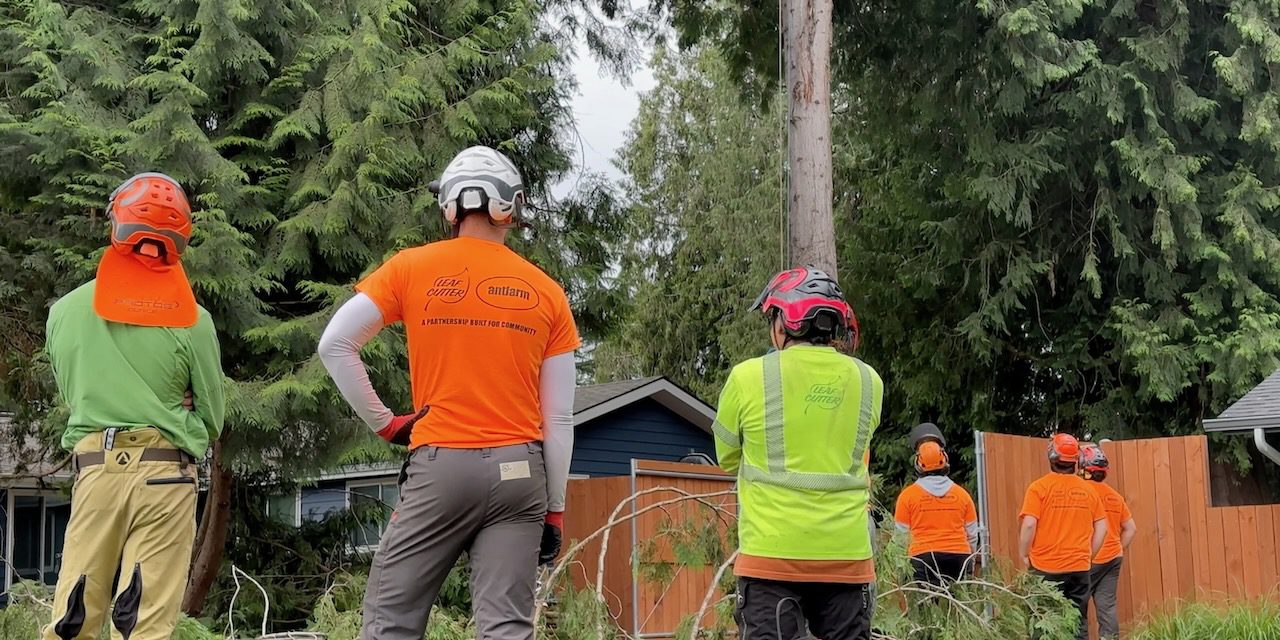
“We’ve had participants move into ecological restoration, arborist work, structural firefighting, wildland fire, and line clearance,” Hancock said. “Seeing people step into those careers is what we’re looking for.”
While crews are thinning vegetation and removing hazard trees, another critical piece of wildfire resilience happens during home assessments.
Michelle Richardson, CWDP Assessment Coordinator, works directly with homeowners to evaluate risk and provide practical recommendations. She says many people are surprised by how small details can make a significant difference.
“The roof is the home’s biggest vulnerability because it has the largest surface area where embers can collect,” Richardson explained. Keeping roofs and gutters clean, even covered gutters, is essential. Leaf litter that accumulates in valleys or near projections can allow wind-driven embers to ignite debris, even if the roof itself is noncombustible.
Decks are another common concern, particularly when combustible materials are stored underneath or against exterior walls. Richardson emphasizes the “Zero Zone,” the first five feet around a home. “Remove all vegetation in the five-foot zone,” she said. “Ideally, this area would be rock.” During fire season, it should also be free of combustible items such as patio furniture and firewood.
Early-season dryness simply means starting cleanup sooner. “Clean your roof and gutters. Rake the five-foot zone. Trim dead vegetation within 30 feet of the home,” Richardson said. “During high fire danger, especially Red Flag warnings and east wind events, running a sprinkler daily in that five-foot zone can make a difference.”
Home assessments often uncover overlooked vulnerabilities such as attic and crawlspace vents. Standard quarter-inch mesh can allow ember entry, while one-eighth-inch mesh offers better protection.
Public funding for wildfire mitigation carries accountability requirements, including documenting structures impacted, skills developed, and measurable community benefit. That structure ensures public investment produces tangible results.
As uncertainty around snowpack and summer conditions continues, AntFarm’s crews are focused on preparation rather than prediction. “We can’t control the weather,” Hancock said. “What we can control is how prepared we are.”
For young people interested in outdoor work, environmental stewardship, or hands-on technical skill development, the Community Wildfire Defense Program offers structured, paid eight-week sessions. The next session is expected to begin in mid-spring, and recruitment is open for applicants ages 16 to 26 ready to work hard and contribute to community safety.
In a region where wildfire is a recurring reality, preparation is not alarmism. It is stewardship. Through thoughtful public investment and local leadership, AntFarm’s Community Wildfire Defense Program is strengthening both the landscape and the next generation prepared to care for it.